Key Takeaways:
- Federal tax credits alone are no longer a complete financing strategy — local grants, state loan programs, and utility rebates now do much of the heavy lifting for net-zero projects.
- PACE financing has gone fully mainstream in 2026, with average C-PACE deal sizes exploding from $800K in 2017 to $40M today, making it one of the most scalable tools available.
- The residential PACE market is on a steep growth curve — projected to climb from $2.12B in 2026 to $5.40B by 2034 — driven by rising energy costs and the elimination of large upfront capital requirements.
- The most effective net-zero financing strategy is a deliberate stack: PACE as the capital foundation, layered with utility rebates, state loans, and federal tax credits where eligible.
- PACE isn’t right for everyone — property liens, state availability gaps, and near-term sale plans are real considerations that need to be weighed before committing.
If you’ve started pricing out a net-zero home build or deep energy retrofit, you already know the sticker shock is real. High-performance insulation, solar-plus-battery systems, heat pumps, triple-pane windows — it adds up fast. But here’s the thing most homeowners miss: there’s a surprisingly layered stack of local grants, low-interest loans, and creative financing tools designed specifically to close that gap. And in 2026, that stack has never been more robust — or more confusing to navigate.
This guide cuts through the noise. We’ll look at what’s actually available right now, how two key financial mechanisms are reshaping the net-zero funding landscape, and how to figure out which tools apply to your specific project.
Why Federal Incentives Alone Won’t Cut It Anymore
For the past few years, federal tax credits — particularly the 25C and 25D provisions under the Inflation Reduction Act — have been the headline story for homeowners going green. And they’re still meaningful. But relying on federal credits alone is a bit like planning a road trip and only mapping the highway. You’ll miss the shortcuts.
The reality is that local and state-level programs are now doing some of the heaviest lifting. State energy offices, municipal utilities, green banks, and regional development authorities have layered incentive programs on top of federal dollars — and in many cases, these local programs are more accessible and faster to deploy than anything coming out of Washington.
The catch? Federal programs have been in flux. The political environment around clean energy funding has introduced uncertainty, and several rebate programs that were rolled out under the IRA are still patchy in their state-by-state availability. That volatility has pushed more savvy homeowners and developers toward financing structures that don’t depend on Washington’s next move.
The PACE Boom: A Financing Tool That’s Gone Mainstream

If you haven’t heard of PACE — Property Assessed Clean Energy — financing by now, pay attention, because it’s become one of the most powerful tools in the net-zero toolkit.
Here’s how it works: instead of taking out a traditional loan tied to your creditworthiness, PACE financing attaches the loan to your property itself. Repayment happens through your property tax bill over a long term — typically 10 to 30 years. When you sell the property, the assessment can transfer to the new owner. No huge upfront check. No refinancing required. Just a steady line item on your tax bill, often offset by the energy savings the upgrades generate.
What’s remarkable is how fast this once-niche product has scaled. According to NJPACE, average C-PACE deal sizes have surged from roughly $800,000 in 2017 to $40 million by 2026 — a reflection of how deeply institutional lenders have embraced the product as a mainstream capital stack component. That’s not a marginal shift. That’s an entirely different category of financing.
Industry insiders describe 2026 as a “reset and re-pricing” year for commercial real estate, with C-PACE demand surging over the past six months as tightening credit conditions push developers toward long-term, fixed-rate alternatives. What started as a tool for smaller residential solar installs has grown into a mechanism closing nine-figure construction loans.
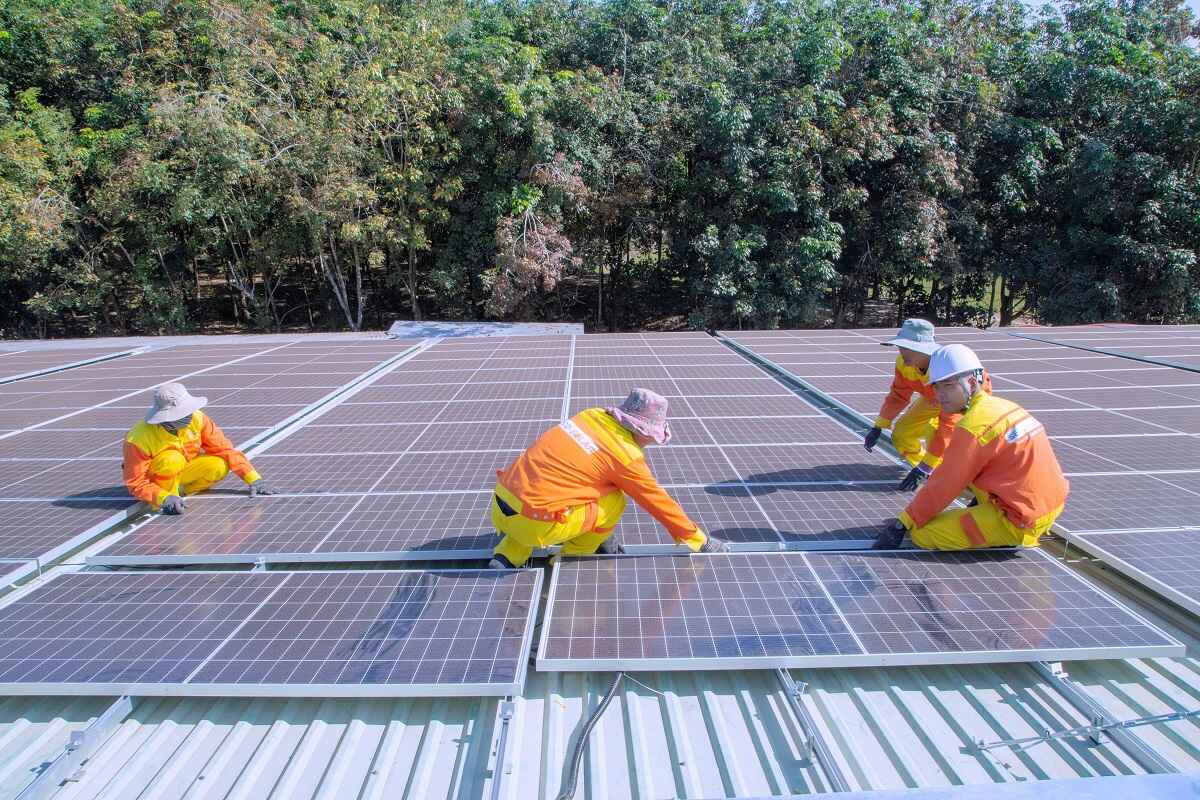
For residential homeowners, the dynamics are similar but scaled down. Residential PACE (R-PACE) programs let you finance solar panels, battery storage, insulation upgrades, roofing, windows, and HVAC systems without touching your mortgage or personal credit score. The loan lives with the house — which is either a feature or a bug depending on your timeline (more on that in a moment).
The Market Numbers That Tell the Story
The growth trajectory here isn’t just anecdotal. A May 2026 market analysis from Intel Market Research values the global solar-and-home-battery PACE financing segment at $2.12 billion for 2026, with projections pointing toward $5.40 billion by 2034 — a compound annual growth rate of 12.4%. That kind of sustained growth doesn’t happen in a niche. It happens when a product solves a real problem at scale.
The driver behind those numbers is straightforward: upfront cost remains the number one barrier to residential clean energy adoption, and PACE is structurally designed to eliminate it. By spreading repayment across property tax assessments spanning 20 to 30 years, PACE programs allow homeowners to adopt renewable energy systems without large upfront capital or the stringent credit requirements that often block access to traditional solar loans.
For households that have the equity but not the liquid capital — which describes a lot of homeowners — this is genuinely transformative.
What to Know Before You Go PACE
PACE sounds almost too good, so let’s be straight about the tradeoffs. First, the assessment does create a lien on your property. If you plan to sell in the near term, that lien needs to be disclosed, and some buyers (and their lenders) get skittish about it. It’s not a dealbreaker, but it’s a conversation you’ll need to have.
Second, PACE availability varies by state. As of mid-2026, residential PACE programs are active in a handful of states — California, Florida, and Missouri being the most robust markets — while commercial C-PACE has broader reach across roughly 40 states. Before you get excited about a PACE option, verify whether your state and municipality have an enabling program in place.
Third, interest rates on PACE financing, while competitive, aren’t always the lowest available. If you qualify for a home equity line of credit or a green mortgage product at a lower rate, run the numbers side by side.
Understanding these nuances matters even more when you consider the full picture of what a net-zero build actually costs. If you haven’t already dug into the real financial anatomy of these projects, this breakdown of the hidden costs of building a net-zero home in 2026 is required reading before you start layering incentives onto a budget that might be missing several line items.
Stacking Grants and Loans on Top of PACE
PACE works best when it’s not the only tool you’re using. Think of it as a foundation layer — it handles the bulk of the capital need without requiring upfront cash. Then you stack on top.
Local utility rebates are often the most underutilized piece of the puzzle. Many municipal utilities and rural electric cooperatives run rebate programs for specific equipment — heat pumps, smart thermostats, insulation, EV chargers — that don’t show up in any federal database. Call your utility directly and ask what rebates are available for the current billing year.
State energy office programs range from direct grants (especially for lower-income households) to low-interest green loans administered through state-chartered green banks. Programs like DC Green Bank’s C-PACE initiative and similar structures in states like Connecticut, New York, and Michigan offer financing terms that would be hard to beat through private lenders.
HUD and USDA programs are increasingly recognizing energy certifications as qualifying criteria. For instance, DOE’s Efficient New Homes certification now opens the door to HUD’s Housing Trust Fund grants for qualifying affordable housing projects, as well as CIRRUS gap financing through PACE Equity Finance — a below-market-rate loan product that can fill funding holes that senior lenders won’t touch.
Community Development Financial Institutions (CDFIs) are another underutilized resource. These mission-driven lenders often operate green lending programs in underserved markets where traditional banks won’t play.
How to Find What’s Available in Your Area
The frustrating truth is there’s no single national database that reliably aggregates local incentives in real time. The landscape is patchy, and programs open and close with budget cycles. That said, here’s a workable approach:
Start with the DSIRE database (dsireusa.org), which tracks state and local incentive programs by zip code. It’s not always perfectly up to date, but it’s the best starting point for mapping what’s available.
Then contact your state energy office directly. Most states have an energy efficiency or clean energy division that can point you toward current grant cycles and loan programs. Ask specifically about programs for net-zero or zero-energy-ready construction — these often have separate funding pools from general weatherization programs.
For PACE specifically, search for the PACE administrator in your county. In states with active programs, administrators like Ygrene, Renew Financial, and PACE Equity have local representatives who can pull your property, assess your equity position, and generate a financing proposal quickly.
Finally, loop in a green mortgage specialist or HERS rater early in your project planning. These professionals often know about local incentive windows before they’re widely publicized, and they can help you sequence the applications so you’re not leaving money on the table.
In Summary
Financing a net-zero project in 2026 isn’t a single-loan proposition. The most effective approach is a deliberate stack: PACE financing as the primary capital layer, layered with utility rebates, state loan programs, and where eligible, federal tax credits. The homeowners and developers hitting their net-zero targets without wrecking their balance sheets are the ones who approached financing with the same rigor they applied to their building envelope design.
The tools are there. The market data makes clear that PACE alone is scaling into a multi-billion-dollar mainstream product, and the local grant and loan ecosystem around it has never been deeper. What it takes now is knowing where to look — and starting that search before you’ve already broken ground.